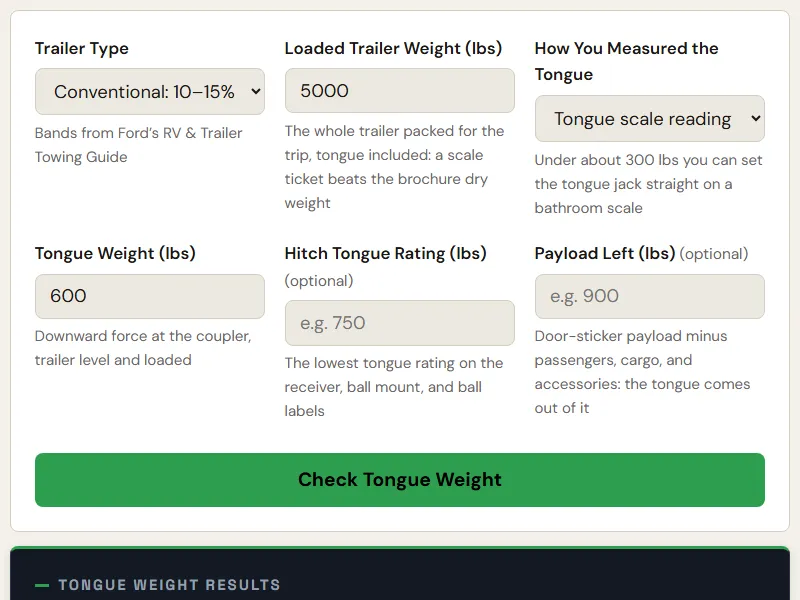
tongue %        = tongue weight / loaded trailer weight x 100   (graded at one decimal, as printed)
band            conventional 10-15%   fifth-wheel king pin 15-25%
target range    = loaded trailer weight x band low % ... x band high %

bathroom-scale lever (moments about the block):
tongue weight   = scale reading x (block-to-scale distance) / (block-to-coupler distance)

limits: tongue weight must not exceed the hitch tongue rating or the payload you have left
Tongue weight is the downward force the trailer's coupler puts on the hitch ball. Ford's RV & Trailer Towing Guide puts the number plainly: trailer tongue load weight should be 10 to 15 percent of total loaded trailer weight, and king pin weight on a fifth-wheel should be 15 to 25 percent. The denominator is the loaded trailer, water and gear included, not the brochure's dry weight, which is why a trailer that measured fine empty can tow badly packed.
Too light and the trailer steers the truck. When too little of the trailer's weight sits ahead of its axles, the trailer's rear has the leverage, and a gust, a passing truck, or a quick lane change can start it swinging. Ford's guide warns that too little tongue weight can cause the trailer to wag its tail or jackknife. Moving heavy cargo forward of the trailer axle is the fix: shifting weight inside the trailer changes the tongue weight without changing the trailer's total.
Too heavy and the tow vehicle pays. The tongue load sits behind the rear axle, so it loads that axle by more than its own weight and lifts some load off the front wheels, the same lever the calculator shows. Ford's guide says the tongue load, passengers, and cargo together cannot push the vehicle past its rear axle rating (GAWR) or its GVWR. That is why the calculator checks the tongue against the payload you have left: every pound on the ball is a pound of payload gone.
The bathroom-scale lever is plain statics. Rest a board on a block at one end and on a bathroom scale at the other, then set the coupler on the board between them. With the board in equilibrium, the moments about the block balance: the scale reading times its distance from the block equals the tongue weight times the coupler's distance from the block. Put the coupler a third of the way from the block and the scale reads a third of the tongue, so you multiply by three. The distances only need to share a unit, because only their ratio matters.
The verdict grades the printed percentage. The calculator rounds the tongue percentage to one decimal and grades that figure, so the number on screen and the verdict always agree: 10.0 percent is in range, 9.9 is light. The hitch and payload checks are strict: equal to the rating passes, a pound over does not. For trailers up to 2,000 pounds, Ford's 2026 guide caps tongue load at 200 pounds on its vehicles, so check your own owner's manual for a light-trailer limit like that one.